
The Feelings Wheel: unlock the power of your emotions

Clinically reviewed by Dr. Chris Mosunic, PhD, RD, CDCES, MBA
Learn how to understand and process your emotions, increase self-awareness, enhance emotional communication, and boost your well-being with the Feelings Wheel.
Sometimes feelings can be big and intense, and other times they’re quiet, buried away, and harder to recognize. If you’re feeling frustrated and angry, it might be difficult to point to just one feeling, but having several to choose from may help you to zero in on exactly what’s going on inside.
Enter: The Feelings Wheel. The brainchild of Dr. Gloria Willcox, the Feelings Wheel can help us put words to our emotions and to care for our mental health.

What is the Feelings Wheel?
The Feelings Wheel offers a unique and specific approach to identifying and understanding emotions. It’s a tool that allows people to better navigate their inner world and build healthier emotional intelligence.
Dr. Gloria Wilcox's Feelings Wheel draws from a range of disciplines, including psychology, neuroscience, and linguistics.
How does the Feelings Wheel work?
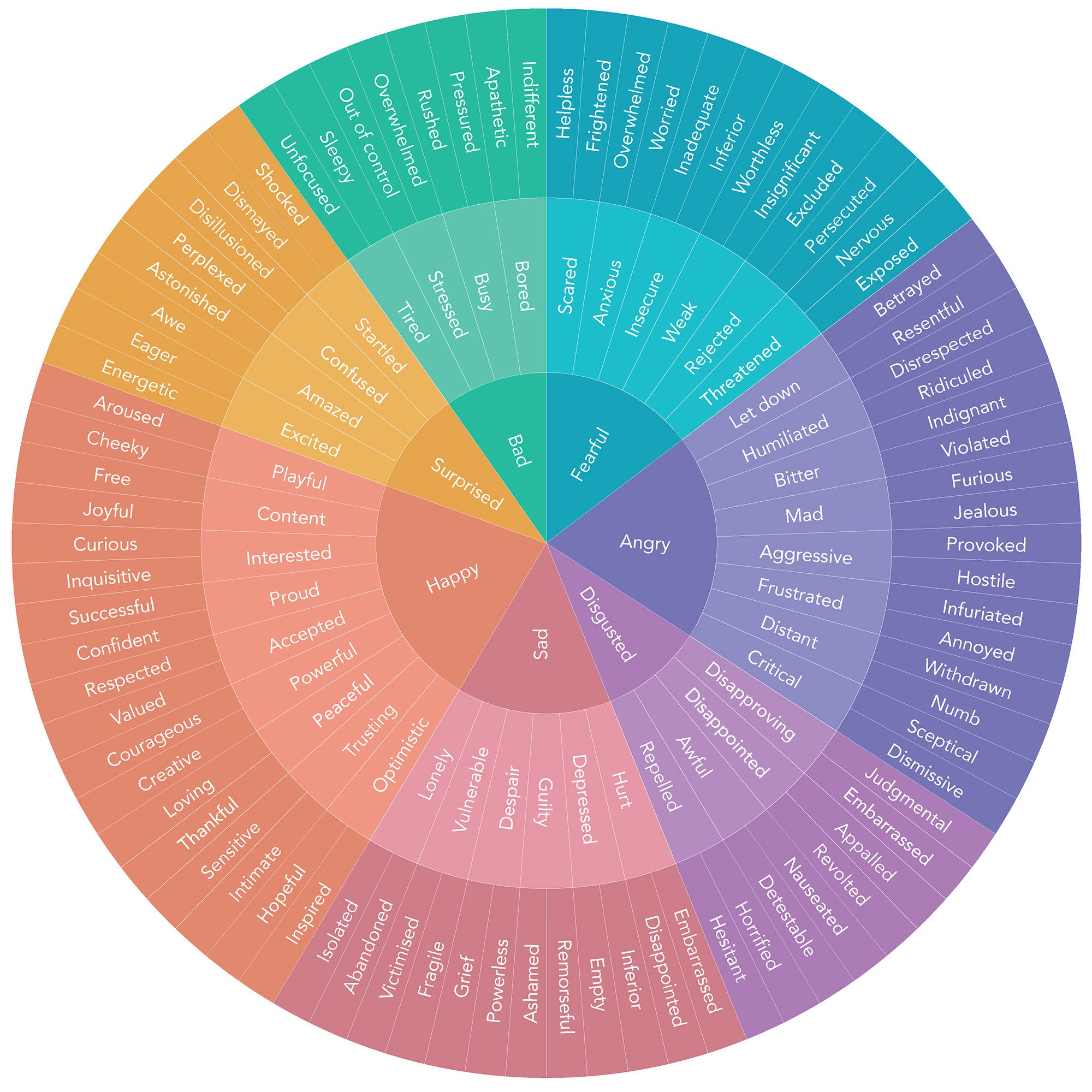
The Feelings Wheel organizes the different dimensions of feelings we may have into several categories and subcategories to help you pinpoint exactly how you’re feeling, which can be helpful, especially if you’re overwhelmed by your emotions or in a heated communication.
At first glance, the Feelings Wheel resembles a color wheel, with concentric circles representing different layers of emotions. The Wheel is divided into primary emotions, secondary emotions, and tertiary emotions. Each layer looks closer into the nuances of emotional experiences, allowing people to name their feelings more precisely.
Primary emotions: The innermost circle of the wheel consists of broad primary emotions, such as happiness, sadness, anger, and fear. These emotions serve as the fundamental building blocks of our emotional experiences. They provide a general sense of how we are feeling, acting as a starting point for further exploration.
Secondary emotions: As we move outward, the wheel introduces secondary emotions that stem from the primary emotions. These emotions offer a more specific understanding of our feelings. For example, under the primary emotion of anger, secondary emotions like frustration, annoyance, and resentment can be found. This layer acknowledges that emotions are rarely just one thing. They often show up as a blend of different feelings.
Tertiary emotions: The outermost layer of the Feelings Wheel shows tertiary emotions, which are the most specific and detailed emotions one can experience. These emotions capture the subtle distinctions that make each emotional experience unique. Under frustration, for instance, tertiary emotions might include impatience, exasperation, or agitation.
Why use the Feelings Wheel?
The Feelings Wheel can serve as a guide to understanding the web of emotions we all feel and how they connect to one another. It’s a powerful tool that can help you explore your feelings more deeply and also express them more accurately so you can get the support you need or process whatever emotions you’re navigating.
Here are some of the benefits of using the Feelings Wheel:
The Feelings Wheel facilitates effective communication: Clear and accurate communication of emotions is pivotal in maintaining healthy connections with others. With the Feelings Wheel, you can effectively communicate your emotional states, enabling your loved ones or colleagues to respond to you with empathy and support. This tool helps break down barriers in conversations and fosters open dialogue about feelings.
The Feelings Wheel encourages mindful reflection: Being able to reflect on our emotions can benefit our emotional growth and well-being. The Feelings Wheel serves as a mirror that reflects the mix of emotions within us. As you explore the various segments of the Wheel, you may discover emotions you hadn't previously recognized or considered.
This exploration increases self-awareness, allowing you to gain insight into your thoughts and behaviors.
The Feelings Wheel can support emotional regulation: Emotionally regulating oneself is a fundamental aspect of mental well-being. The Feelings Wheel aids in this process by helping you to identify and label your emotions, which is the first step towards managing them.
When we can figure out our emotions, we are better equipped to implement strategies for emotional regulation. This might involve techniques like mindfulness, deep breathing, or engaging in activities that align with the corresponding emotional needs.
💙 If you’re feeling stressed or overwhelmed, try this Sign of Relief guided meditation with Jay Shetty.
The Feelings Wheel can help you identify emotional patterns and triggers: The Feelings Wheel validates the range of emotions we experience and can help us better work out our triggers. It helps us understand that our emotional responses are valid and normal, which is especially important in cultures or environments that might stigmatize certain emotions.
This validation helps build a sense of empowerment, encouraging people to embrace their feelings without judgment and also to better learn how to manage them when they come up.
The Feelings Wheel can help support your mental health: The Feelings Wheel has found a valuable place in therapy and mental health treatment. Therapists often use it as a tool to facilitate discussions about emotions, allowing clients to look deeper into their experiences. Moreover, it aids therapists in teaching clients about emotional intelligence and coping strategies. As a result, the Feelings Wheel contributes to more effective therapeutic outcomes.
The Feelings Wheel helps to enhance emotional awareness: Empathy and emotional awareness are key in understanding and sharing our feelings with others. These are cornerstones of healthy relationships and effective communication.
The Feelings Wheel can help people grow empathy by encouraging them to explore emotions beyond their own experiences. By engaging with the wheel, people develop a broader perspective on emotions, enabling them to relate to and support others more effectively.
Using a tool like The Feelings Wheel can help you to get better in tune with yourself and your feelings. It can be a great tool for communication, or even when journaling your feelings.
The Feelings Wheel can support psychological flexibility: The Feelings Wheel can help build psychological flexibility, which is the ability to notice what you're feeling without getting stuck there. When emotions show up fast and loud, it's easy to react on autopilot. Naming a feeling more precisely creates a little space between the emotion and your reaction to it.
That space gives you options, because different feelings need different kinds of care. If you label everything as "upset," it's hard to know what would help. But when "upset" becomes "overwhelmed," "rejected," or "ashamed," your next step gets clearer. Research on emotion differentiation finds that people who name their feelings in specific terms tend to regulate them more effectively:
Overwhelmed: A pause, fewer inputs, or a grounding exercise
Lonely: Connection and reaching out to your support system
Resentful: A cue that a boundary needs attention
Ashamed: Self-compassion and a safer conversation, rather than more self-criticism

How to use the Feelings Wheel
The Feelings Wheel is more than a visual representation of emotions; it's a hands-on tool that helps people develop emotional intelligence. Learning about your feelings encourages you to engage in introspection, reflecting on the subtleties of your emotions and the deeper meanings behind them. Here's how to use the Feelings Wheel:
1. Download the Feelings Wheel
We recommend downloading this handy tool for the next time you can’t quite name what’s arising within.
We also included a black-and-white version of the Feelings Wheel so that you can color it in yourself. Coloring the wheel is an opportunity to get to know and contemplate each word.
💙 Download the Feelings Wheel here
2. Check in with yourself
The first step in using the Feelings Wheel is to take a moment to check in with how you feel in the moment. Start with what happened. Maybe a text went unanswered, or a meeting went sideways. Take a few breaths and notice how your body feels. Do you have tension anywhere? A tight chest might point to anxiety, a hot face or clenched jaw to anger, a heavy or flat feeling to sadness. Then check in with your emotions. Do you feel like you want to cry, hide, or yell? Scan the wheel to discover what adjective best describes your state, and then allow that understanding to help you decide how you want to meet the moment.
Allow room for more than one feeling at once. You can feel relieved and guilty, or excited and scared, at the same time. The Feelings Wheel works best when it makes space for that kind of overlap.
Figuring out the basic category of feelings you're in can help you to name exactly what's going on. Sometimes we struggle to accurately identify our emotions beyond the basic ones. The Feelings Wheel helps us examine our emotional states, allowing us to differentiate between, for instance, sadness and melancholy. This heightened emotional awareness is the cornerstone of emotional intelligence, encouraging healthier self-expression and communication.
3. Communicate your emotions
Once you know exactly what you’re feeling, you can start communicating it either to yourself, your partner, or someone else in your support system.
Expressing emotions can be a challenging task, especially when words fall short of capturing the complexity of feelings we’re having. The Feelings Wheel offers a common language for describing emotions, enhancing communication between people. This can be particularly helpful in personal relationships, workplace settings, and therapy sessions, where understanding and articulating emotions is crucial.
4. Take appropriate action
Once you’ve expressed your feelings, you can take action. By accurately identifying our emotions, we can better understand the triggers and underlying causes of our feelings. This insight gives you room to manage your emotional responses more effectively, reducing impulsive reactions and promoting thoughtful, measured responses.
💙 Feeling stressed? Try SOS Breath Work with Chibs Okereke.
5. Track your emotional trends over time
The Feelings Wheel also works as a tracking tool. Writing down a few emotion words each day can surface patterns that are hard to notice in the moment, like feeling irritable after a bad night's sleep, anxious before certain conversations, or numb during stretches of overload. Over time, those patterns can point to your triggers and to what supports your well-being. They can also give you clearer information to bring into therapy or another form of support.

The Feelings Wheel FAQs
What is The Feelings Wheel?
The Feelings Wheel, created by Dr. Gloria Willcox, can help us put words to our emotions, which in turn can help us care for our mental health. Sometimes feelings can be big and intense, and other times they are buried away and harder to recognize. If you’re feeling frustrated and angry, it might be difficult to point to just one feeling, but having several to choose from may help you to zero in on exactly what’s going on inside.
How can I use it?
The Feelings Wheel serves as more than just a visual representation of emotions; it's a practical tool that empowers people to develop their emotional intelligence. The wheel, made of concentric circles, shows primary emotions and then breaks them down further into secondary and tertiary emotions to help you identify exactly how you’re feeling. It’s a great tool for communication, or even journaling exactly how you’re feeling. Download it here.
What is it best used for?
The Feelings Wheel is best used for communication, but it also enhances emotional intelligence, empathy, reflection, and emotional regulation.
Are there any downsides?
There are very few downsides to expressing your emotions when you’re able to do it in a mindful manner. If you feel nervous about expressing how you feel, you can use The Feelings Wheel with a mental health professional. That way, if expressing the feelings triggers anything big and scary, you have an advocate there to help you process it.
Where can I find The Feelings Wheel?
You can download it for free right here.
READ NEXT:
5 Benefits of Tracking Your Mood